
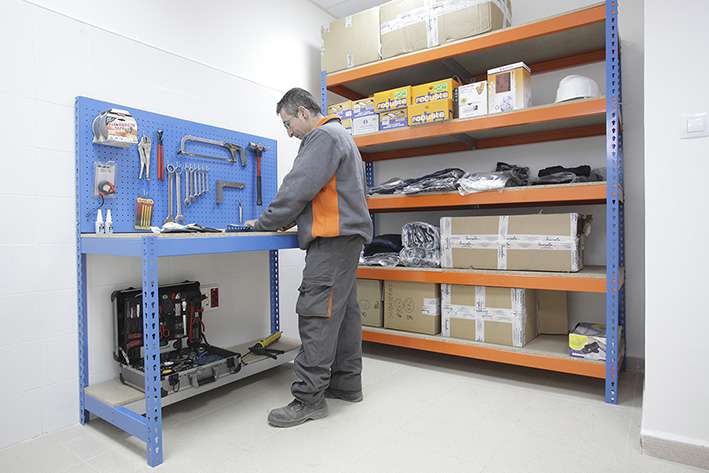
Having a good workbench is essential if you want to work comfortably, safely, and efficiently. Everyone pays attention to that, but one of the most overlooked aspects is its height. Choosing the height of the workbench Proper posture not only influences productivity, but also body posture, fatigue, and the prevention of future injuries.
Whether it's for a home workshop, a garage, a warehouse, or a professional environment, understanding how to adapt the bench height to each type of task will make a difference in your day-to-day work.
In this article SimonRack We explain how to choose the workbench height according to different factors.
Why is the height of the workbench so important?
A workbench that's too low forces you to constantly bend over, while one that's too high puts strain on your shoulders and wrists. Either situation can lead to physical discomfort, muscle strain, and a loss of precision in manual tasks.
When working for long hours, a workbench at the wrong height can cause back, neck, and arm pain. Therefore, choose the height of the workbench Properly chosen is a direct investment in health and performance.
The relationship between ergonomics and task type
Not all tasks require the same working height. Ergonomics recommends adjusting the workbench according to the effort, precision, and weight of the materials being worked on. For example, tasks involving force and pressure, such as hammering, sanding, or assembling heavy parts, usually require a lower workbench. Conversely, precision work, such as assembling small components or electronics work, is better suited to a slightly higher workbench.
Recommended height according to the type of work
Although there is no single measurement that fits all cases, there are indicative ranges that help to choose the height of the workbench more suitable.
For heavy or physically demanding work, such as carpentry, metalworking, or assembling large parts, the ideal work surface height is below elbow level. This allows you to exert more force without straining your back.
For general DIY or maintenance tasks, a height roughly at elbow level is usually the most balanced. It offers comfort for extended periods and allows you to alternate between precision and moderate force.
For high-precision work, such as electronics, model making, or repairing small parts, the workbench should ideally be a few centimeters above elbow height. This prevents you from bending over and improves visibility and control.
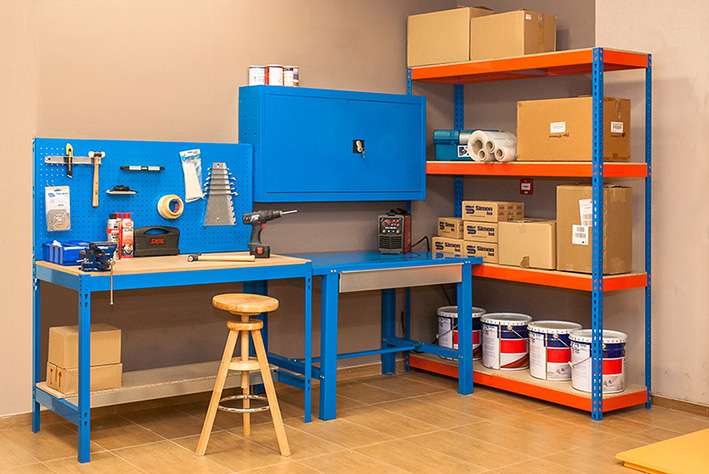
How does a person's height influence this?
Height is another key factor. Two people performing the same task may need different heights to work comfortably. Therefore, when choose the height of the workbench, It is important to consider who will be using it.
As a general guideline, a person of average height can usually work comfortably with workbenches between 85 and 95 cm high for general tasks. However, this measurement can vary by several centimeters depending on body height and the type of work.
Adjustable workbenches: a more versatile solution
One of the best options for adapting to different tasks and users is to choose a height-adjustable workbench. These types of benches allow you to adjust the surface according to the activity being carried out, making them very useful in multi-purpose workshops.
Furthermore, adjustable benches help prevent injuries, as they allow you to change your posture throughout the day, reducing accumulated fatigue. It's all advantages.
Other aspects to consider when choosing the height
We already know that height is a key factor, but be aware, it's not the only one. For the workbench to be truly functional, it's also important to consider other factors:
- The type of surface: wood, metal, or a combination.
- Stability and load capacity.
- The workshop or garage space.
- The possibility of adding accessories such as shelves, drawers or perforated panels.
All these elements influence the comfort and efficiency of daily work.
Common mistakes when choosing the height of the workbench
One of the most common mistakes is choosing a bench simply because it's attractive or inexpensive, without considering its intended use. Another common error is failing to recognize that the type of work required can change over time, rendering a fixed height insufficient.
It is also common not to properly measure the available space or not to take into account footwear or the anti-fatigue mat, which can alter the effective working height.
These are all details that are overlooked, but when it comes down to it, they are very important.
How to choose the right workbench?
For choose the height of the workbench Ideally, it's best to know what you'll be using it for, your height, and how much time you'll be spending working on it. If you do all kinds of activities, an adjustable bench will be the most practical option.
Are you looking for a workbench? In SimonRack We have a wide variety to choose from.
Investing in a well-designed bank tailored to your needs isn't just about convenience, but about long-term health and efficiency. Even a small adjustment can make a big difference in your daily life!





 Español
  Deutsch
  Français
  Italiano
  English (UK)