

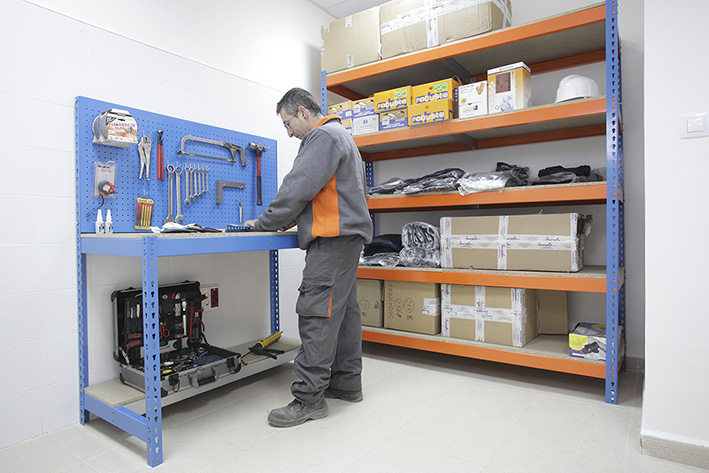
Precision work, such as electronic assembly, jewelry making, watchmaking, model making, or fitting small parts, depends as much on the workstation as on the skill of the person performing it. A stable workbench, at the correct height, with organized tools and good lighting, reduces errors, shortens each task, and limits fatigue during long workdays.
To set up a precision workbench It's not about buying the biggest table. It's about getting four things right: the bench, the organization, the lighting, and, if nothing standard fits, the dimensions. Here are the criteria for each.
Before going into detail, here's a summary of what your position should include:
| Element | What to look for | Why it matters |
|---|---|---|
| Surface | Flat, smooth and easy to clean | Small parts are not lost and measurements are reliable. |
| Structure | Metallic, rigid and level | No vibrations when adjusting, welding, or measuring |
| Height | Slightly above the elbow | Less tension in the neck, shoulders, and back |
| Organization | Drawers and perforated panel | Each tool has its place and is within easy reach |
| Lightning | General lighting and adjustable localized lighting | You see marks, edges, and defects without shadows |
How to choose a precision workbench
The type of work dictates the needs. Someone who solders electronic boards doesn't have the same requirements as someone who sets stones or adjusts mechanical parts. Consider three aspects: surface area, resistance, and height.
Surface: flat, smooth and suitable for the material
For precision, the countertop is your reference surface. It has to be flat, without gaps or warping, and easy to clean so that a two-millimeter screw doesn't disappear into a groove.
- Wood, MDF or laminate: It dampens vibrations better, doesn't damage delicate parts, and is comfortable to rest your hands on. The beech laminate also withstands daily wear and tear well.
- Sheet metal: It resists impacts, oils, solvents, and wood shavings. If you already have a workbench with a wooden worktop, you can protect it with a wood cover sheet; SimonRack manufactures it for its BT workbenches in widths from 900 to 1800 mm.
- Electronics: If you handle components sensitive to static electricity, add a grounded anti-static mat to the countertop.
Pay attention to the dimensions: a depth of about 60 cm is sufficient for most fine work, but if you're working with a microscope, soldering station, or magnifying glass, you'll need something more. SimonWork workbenches offer widths of 910, 1210, and 1510 mm, and some models offer depths between 610 and 760 mm.
Strength: stability before weight
Precision work rarely puts much weight on the workbench, but stability matters more than it seems. If the table wobbles when you tighten the vise or rest your elbow on it, the measurement or marking will be inaccurate.
- Choose a rigid metal structure, with reinforcements and no play in the joints.
- Level the legs before starting and, if the bench is fixed and heavy, consider anchoring it to the wall.
- If you choose a bench with wheels, make sure they have brakes, and always lock them while you work.
- Add up the weight of what will go on top: bench vise, pillar drill, full cabinet or drawers.
For reference, the workbenches SimonRack racks generally support between 500 and 1000 kg depending on the model, a generous margin to equip the workstation without compromising rigidity.
Height: the elbow rule
The correct height depends on your height and the task. The reference point is the height of your elbow with your arm relaxed: for precision work, the workpiece should be slightly higher so you can see it up close without bending over and can rest your forearms or hands on it.
| Task type | Height of the plane relative to the elbow |
|---|---|
| Precision with very high visual demands | Between 10 and 12 cm above |
| Precision with hand support | Between 5 and 7 cm above |
| Light work with moving hands | Slightly below |
| Heavy or forceful work | Between 10 and 30 cm below |
These guidelines are based on the INSST ergonomic checklist. If you work sitting down, adjust your chair or stool so your elbows are at the correct height, and use a footrest if your feet don't reach the floor. And if several people share a workbench, the golden rule is that the seat should be adjustable.
Organization: drawers, pegboard and accessories
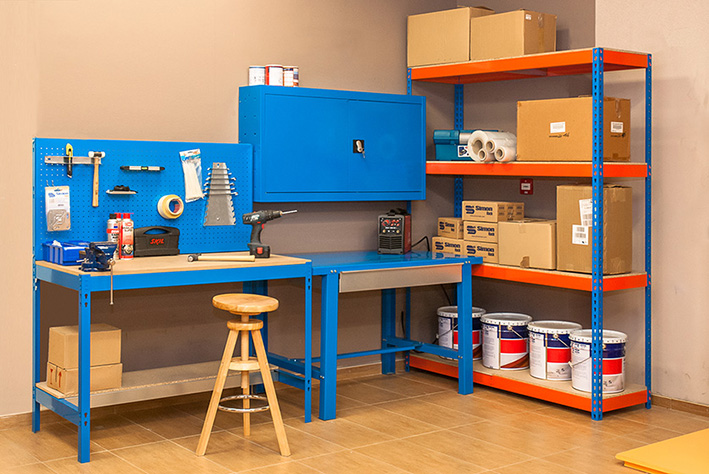
In a precision workstation, the countertop must be clear. Everything you're not currently using should have a designated place, either in plain sight or within easy reach.
Drawers for small parts and consumables
Drawers with telescopic slides open fully, revealing the contents to the back—essential when storing screws, spare parts, or measuring instruments. Models like the SimonWork BT 3 Box and BT 5 Box include them, and the drawers allow you to separate items by type or size.
Perforated panel PanelClick
PanelClick is SimonRack's perforated panel for SimonWork workbenches. It allows you to hang hand tools, keeping them visible and within easy reach, without taking up workspace. It is available in heights of 400 and 600 mm, widths of 900, 1200, and 1500 mm, and in various colors, with kits of 8, 14, or 22 hooks and accessories.
To complete it you have screwdriver holders, Allen key holders, flat key holders, drill bit holders, shelves, double U and T hooks and drawers of different sizes.
How to organize your bank step by step
- Take inventory of the tools you use for each task and remove anything that doesn't belong in the job.
- Classify them by frequency of use: daily, weekly, or occasional.
- Place the ones you use daily on the panel, in the central area and at eye level, where you can reach without stretching.
- Store consumables, screws and small parts in drawers and cabinets, separated and labeled.
- Mark the position of each tool on the panel to see at a glance if any are missing.
- Leave the center of the countertop clear and clear the bench at the end of each day.
Things you don't need on a daily basis, like spare supplies, boxes, or equipment you rarely use, are best kept outside the bank. metal shelving Next to the station they maintain order without taking up workspace.
Lighting: avoid shadows and reflections
Even with the best structure and organization, fine work suffers without good lighting. A few brief guidelines:
- It combines general and localized lighting. A bright spotlight on the piece, with the rest of the workshop in darkness, strains the eyes due to the contrast.
- Position the light so that the hand does not cast a shadow. If you're right-handed, you can access it from the front or the left; if you're left-handed, the opposite. An adjustable arm allows you to adapt it to each task.
- Control your reflexes. On polished metal, chrome or varnish, change the angle of the light or use a diffuser until the direct glare disappears.
- Choose the right font. A neutral light with good color rendering helps you distinguish cable colors, brands, and finishes.
- For the finest detail, A magnifying glass with integrated light or a microscope can reach where the eye cannot.
If the bank is in a workplace, remember that Royal Decree 486/1997 sets a minimum of 1000 lux in areas where tasks with very high visual demands are carried out.
Customized banks: how to configure the bank you need
When the available space, posture, or type of work doesn't fit a standard model, a custom-made workbench is the solution. To make sure you don't miss anything, define these points before ordering:
- Measures: Width and depth according to the space and the equipment you will use, and height according to your elbow and the task.
- Surface: wood, laminate or metal, depending on the materials and products you work with.
- Storage: number of drawers, cabinet or bottom shelf.
- Perforated panel and accessories: which tools do you want to have hanging in view?
- Mobility: fixed, anchored to the wall or with wheels with brakes.
- Finish and color: so that the bench fits in with the rest of the workshop.
With that information, request your configuration in the section of custom-made workbenches by SimonRack. They manufacture in Spain and their technical team assists you in adjusting every detail to your way of working.
Frequently Asked Questions
What height should a precision workbench have?
Slightly above the height of your elbow with your arm relaxed: between 5 and 7 cm if you work with your hands resting on the desk, and between 10 and 12 cm if the visual demands are very high. If you work sitting down, adjust the height using your chair.
Which surface is best for precision work?
A flat, smooth surface. Wood and laminate dampen vibrations and protect delicate parts; metal is more resistant to oils, solvents, and impacts. For electronics, add an anti-static mat.
How much light does a precision workbench need?
In workplaces, Spanish regulations stipulate a minimum of 1000 lux for tasks with very high visual demands. In addition to the quantity, placement is important: localized and adjustable light, without shadows or reflections on the workpiece.
Conclusion
A precision workbench A well-assembled workstation makes a difference in every task: fewer errors, less time spent searching for tools, and less fatigue at the end of the day. Choose a stable surface and structure, adjust the height to your elbow, organize with drawers and a pegboard, and pay attention to the lighting. And if no standard model fits your space or your work style, configure it to your specifications.
Do you need a bench adapted to your way of working?
Choose dimensions, surface, drawers and perforated panel, and the SimonRack team will help you configure your custom workbench.
Order your custom-made bench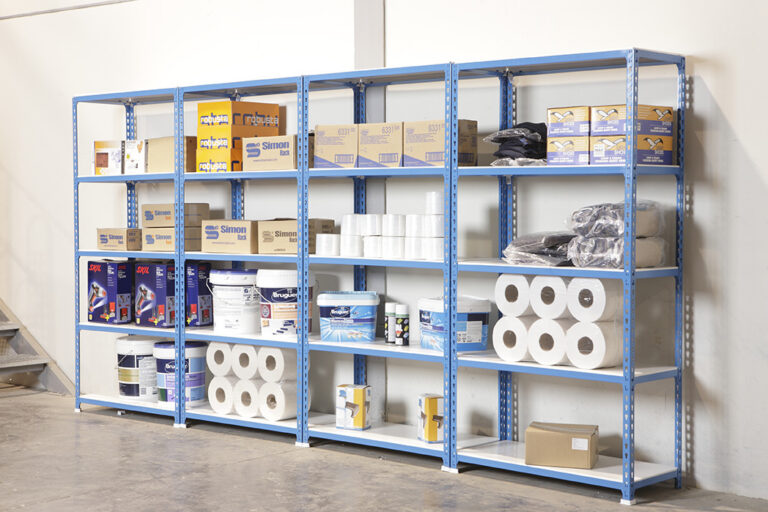



 Español
 Deutsch
 Français
 Italiano
 English (UK)

