

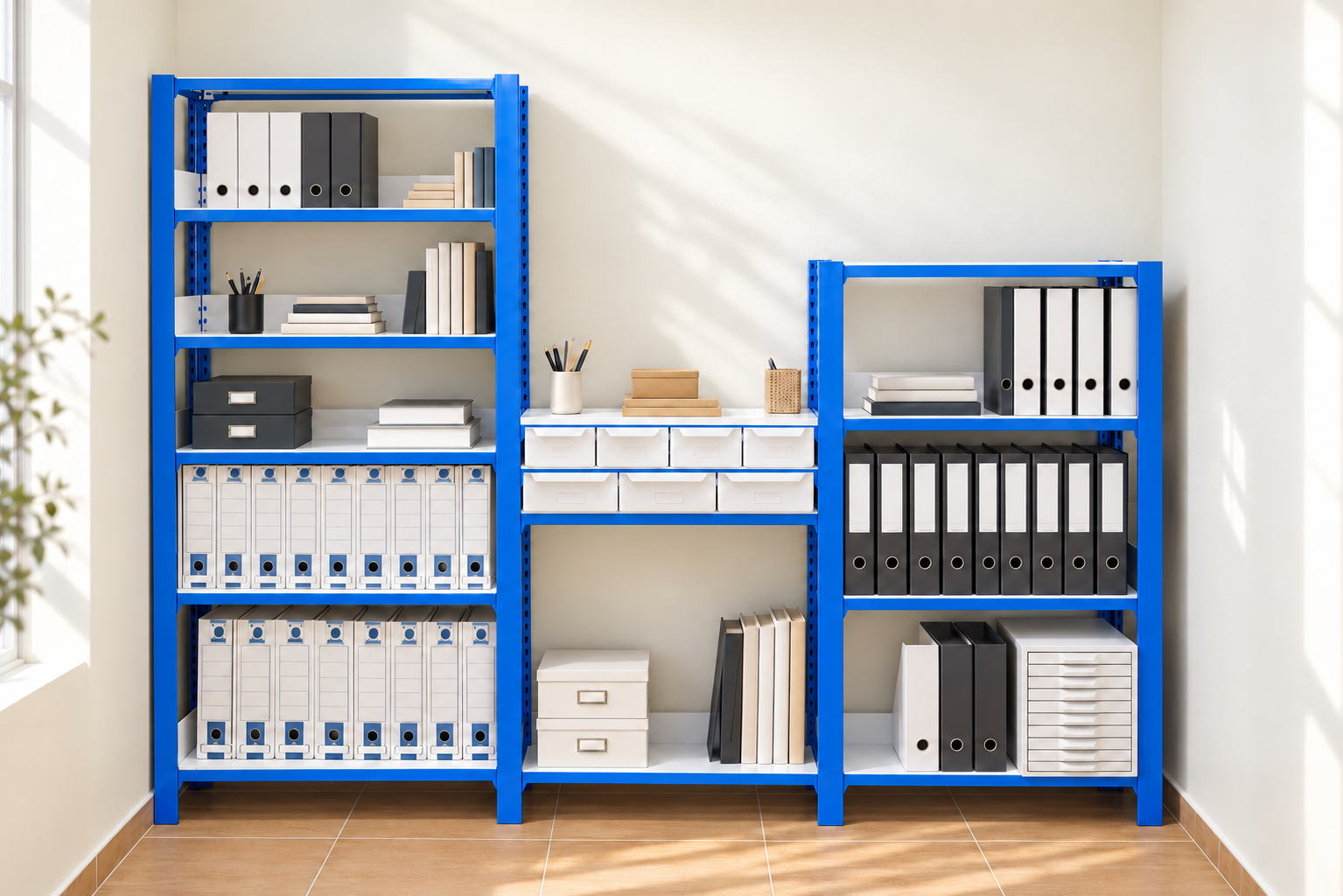
A well-organized archive depends on more than just the number of folders it can hold. It also depends on how documents are stored, how quickly they can be found, and the security of the storage space. That's why more and more offices, studios, and businesses are opting for the advantages of metal shelving to organize their documents.
In this article, we'll review what these structures bring to a document archive, how to choose the right model, and which type of tray best suits each situation. Furthermore, you'll see that the choice isn't limited: you can combine the metal structure with metal or wooden trays depending on the intended use and desired aesthetic.
What a good document archive needs
An archive is a continuous process. Folders, filing cabinets, and boxes of documents weigh more than they seem, especially when they accumulate over years. Furthermore, space is often limited, and it's important to make the most of vertical space without sacrificing accessibility.
Therefore, the storage system must meet several conditions at once:
- To support weight constantly without deforming.
- Keep the documentation organized and visible.
- Adapt to the growth of the archive.
- Facilitate cleaning and maintenance.
- Contribute to a safe working environment.
Main advantages of metal shelving in an archive
The metal shelving They respond very well to all these needs. These are the strengths that are most noticeable in the day-to-day operation of an archive:
Resistance to continuous loads. The steel structure supports the weight of folders and boxes for years. Thus, the shelves maintain their shape even in heavily used archives.
Durability and stability. Metal withstands the test of time, impacts, and daily use well. Furthermore, a good finish protects the structure from wear and tear.
File security. Steel is a non-combustible material. Therefore, metal structures offer added peace of mind in risk prevention, especially in spaces where important documents are stored.
Space utilization. This type of shelving allows you to work at different heights and adjust the distance between shelves. This way, each level can be adapted to the size of the folders or boxes you're going to store.
Simple and modular assembly. There are models with and without screws, and many support additional modules. This allows the archive to grow at the same pace as the documentation.
Easy cleaning and maintenance. Metal surfaces are quick to clean and require no special treatment. Consequently, the archive is kept in good condition with very little effort.
Professional aesthetics. Modern finishes blend seamlessly into offices, workspaces, and archive areas. Therefore, there's no need to choose between functionality and a polished appearance.
If you want to see models designed specifically for this use, check out our metal shelving for archives.
Metal or wooden tray: which one to choose?
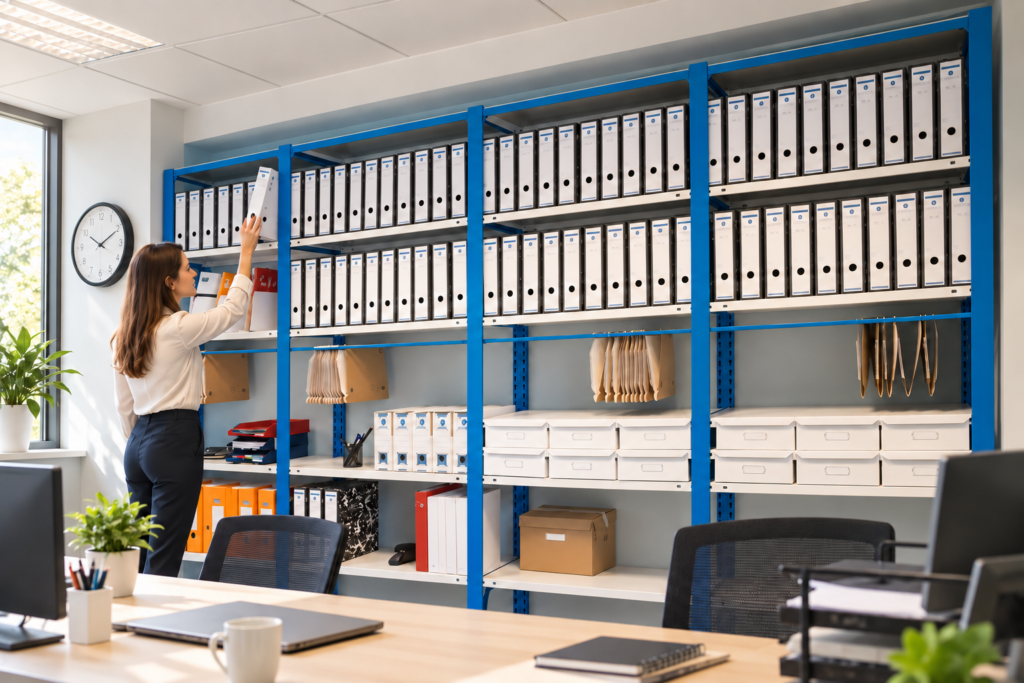
Once the structure is decided, another important choice arises: the type of tray. Both options work very well for filing documents and maintain the advantages of metal shelving in terms of sturdiness and stability. The difference lies in the intended use and the desired finish.
Metal tray. It is the most common choice for high-traffic archives, document storage facilities, and technical areas. It offers great durability, is easy to clean, and maintains a uniform appearance with the rest of the structure.
Wooden tray. It offers a smooth, uniform surface, ideal for placing folders, boxes, and filing cabinets. Furthermore, its warm finish is a perfect fit for offices, reception areas, and other visible office spaces, where appearance matters.
At SimonRack you'll find both versions. If you're looking to combine the robustness of metal with a warmer finish, take a look at our shelves with wooden tray.
Keys to choosing shelving for storing documents
Before buying, it's worth reviewing some aspects that make a difference in the day-to-day running of the archive:
- Load capacity per shelf: Calculate the approximate weight of what you're going to store. For large files, a medium-capacity shelving unit gives you more leeway.
- Height and number of shelves: Choose the height according to the available space and the number of levels according to the size of your folders.
- Shelf back: Check that the boxes and filing cabinets fit without sticking out.
- Mounting system: Screwless models are quick and easy to assemble, while screw-in models are the classic, tried-and-true solution.
- Tray type: metal for more intensive use or wood for areas where the image has more weight.
- Possibility of expansion: If the file is going to grow, choose a system that supports additional modules.
How to make the most of the advantages of metal shelving
Choosing the right shelving is the first step. However, subsequent organization also influences the security and efficiency of your archive. To get the most out of metal shelving, keep these tips in mind:
- Place the heaviest documents on the lower shelves.
- Reserve the central levels for the documentation you consult most frequently.
- Secure the tall shelves to the wall for added stability.
- Label each shelf or box by year, customer, or department.
- Leave some free space on each level for new additions.
- Keep hallways clear for easy and safe access.
Conclusion
An organized, secure, and scalable archive starts with a good storage system. The advantages of metal shelving, such as its strength, durability, modularity, and ease of maintenance, make it a very complete solution for storing documents.
Furthermore, you can customize each shelf to your space by choosing between a metal or wooden tray. This way, you get a functional filing system that also complements your office's aesthetic.


 Español
 Deutsch
 Français
 Italiano
 English (UK)

